
The Credit Card Competition Act (CCCA), first introduced in 2022 and reintroduced in subsequent sessions, aims to limit what its sponsors call the duopoly of Visa and Mastercard. The American Consumer Institute has written elsewhere about why the bill’s other purported benefit, lower costs for consumers, is unlikely to materialize. The underlying premise deserves scrutiny too: even if the duopoly label fits, that doesn’t mean the market lacks competition. Economic literature shows that concentration alone doesn’t reliably produce high prices or other consumer harms.
Mechanically, the CCCA would require that banks have over $100 billion in assets that issue credit cards to offer merchants two payment networks, only one of which could be Visa or Mastercard. Because these networks collect the interchange fees charged on each transaction, the bill’s theory is that adding a non-Visa, non-Mastercard option will increase competition and lower prices. However, labeling a market a duopoly doesn’t establish that it lacks competition, and a closer look at the card network marketplace shows few of the usual signs of anticompetitive behavior.
Blunt claims about competitive impact based on market structure alone run into a problem: for oligopoly research in particular, structure rarely tells the whole story. A review of the existing literature on oligopoly structure found that outcomes depend on variables beyond firm count and market share. Low barriers to entry, for instance, can let competitors enter easily enough that economic theory predicts near-optimal pricing even within a duopoly or a monopoly so long as would-be competitors face low entry barriers.
Empirical and experimental studies show the same pattern: duopoly behavior is hard to predict and varies by circumstance. For lawmakers, that means blanket regulation based on market structure alone is likely to miss the mark. Before writing rules, they should look at the market itself for evidence of harmful market power.
Market Concentration
In theory, a duopoly means two firms hold 100 percent of the market between them. Practice is messier and usually focused on monopoly/duopoly power as opposed to exact definitions. A 2023 Congressional Research Service report puts the market share generally associated with monopoly power at 70 percent and identifies the 50 to 70 percent range as the zone of “greatest uncertainty” for assessing market power.
Applied to a duopoly, that 50 to 70 percent range is a rough but useful benchmark, and by that measure, claims that Visa and Mastercard form a duopoly aren’t baseless. As of 2024, Visa held 52 percent of the credit card network market based on purchase volume, Mastercard nearly 25 percent, and American Express nearly 20 percent, with Discover in the single digits.
While the combined share of Visa and Mastercard hits the 70 percent mark, what is most noteworthy is that American Express is not far behind Mastercard in terms of share. Having such a close third competitor is not something you would expect to see in a noncompetitive duopoly.
Entrenched market power depends on barriers that keep new firms out. In a true duopoly, the two incumbents keep any third competitor from gaining real share. American Express’s position suggests the card network market is better described as an oligopoly than a duopoly.
Have interchange fees gone up?
Interchange fees did rise between 2010 and 2025, from 2.02 percent to 2.36 percent, but that increase significantly lagged inflation. According to Bureau of Labor Statistics CPI-U data, cumulative consumer prices rose more than 46 percent over the same period, over twice the roughly 17 percent increase in interchange fees. If the payments market were genuinely uncompetitive, letting card networks extract outsized rents from merchants, fee growth would be expected to outpace broader price trends, not trail them. The comparatively modest rise in interchange fees points to market discipline, not market failure.
To be clear, an interchange fee rate and the Consumer Price Index measure different things — one is a percentage applied to transactions, the other tracks the price of a fixed basket of goods — so this comparison isn’t a stand-alone economic proof of a competitive market. But as one indicator among several, it undercuts the claim that fee growth reflects unchecked pricing power: a monopolistic actor facing little competitive constraint would have little reason to let its rate grow at a fraction of the pace of everything else in the economy.
Interchange fees are further put into perspective when you look at the cost businesses incur when handling cash. According to research from IHL Group, the cost of handling cash can reach up to 15 percent of a transaction cost, exceeding what would have been charged for an interchange fee.
The signals of anticompetitive behavior in the card payments market are largely absent on close examination: Market share numbers alone don’t support claims of consumer harm from an illegal duopoly. Lawmakers should look at the market’s actual behavior, not just its structure, before advancing the CCCA.
Tirzah Duren is the President and CEO of the American Consumer Institute, a nonprofit education and research organization. Follow Tirzah on X @tzduren
Leah Locke is a Policy Analyst with the American Consumer Institute, a nonprofit education and research organization. Follow Leah on X @leahmlocke
Enjoying this resource?
Subscribe to our newsletter to stay up-to-date on ACI’s latest news, events, and articles!
SHARE THIS
-
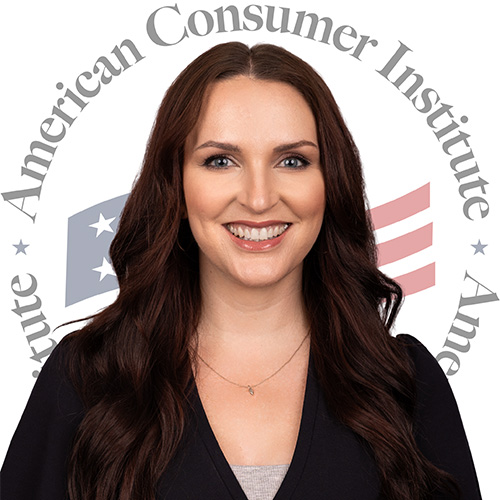
Tirzah Duren
President and CEO
Tirzah Duren is the President and CEO of the American Consumer Institute, where she leads initiatives to advance consumer-centric public policy through rigorous research and analysis. With a passion for exploring diverse policy and regulatory issues, she brings a wealth of experience and a global perspective to her work. -

Leah Locke
Policy Analyst
Leah Locke is a Policy Analyst at the American Consumer Institute focusing on finance and insurance policy.
Subscribe to ACI
Related Resources
Experts
-
Leah Locke
Policy Analyst
-

Patrick Bampfield
Communications Manager

Clear, research-driven insights delivered straight to your inbox.
Subscribe to our newsletter for the latest analysis, media, and policy updates that matter to consumers. Join a growing community focused on understanding the issues shaping your world.
Support ACI
Donate today to support our mission to promote consumer welfare.