

In a recent press conference, President Trump announced the administration will soon be implementing 100 percent tariffs on semiconductor imports, with one huge caveat: companies “building” or “committed to build” in the United States would receive an exemption. Whether those exemptions will materialize is still an open question—and so are many other details.
President Trump’s exemption has been mostly interpreted by the media to mean that companies investing in the United States would not face tariffs on semiconductors coming into the United States. Maybe, maybe not.
The announcement that certain companies would be exempt vaguely suggests a narrower approach to semiconductor tariffs—but that shouldn’t be assumed to be the case. More details are needed. Back in April, the Department of Commerce launched a Section 232 investigation into semiconductors that broadly defines the inquiry as “semiconductors, semiconductor manufacturing equipment, and their derivative products.” That’s much broader than just the chips. Even if certain exemptions narrow the scope of the tariffs, broadly defining terms would expand it. The tariff rates themselves are also unclear. In January, Trump suggested the tariff rates could be as low as 25 percent, but last week told reporters the rate could be as high as 200 or 300 percent. As Politico put it: “Trump keeps the tech world on edge.”
If certain chips are exempted, that’s good news. Semiconductors run the world. Restricting the supply would massively drive up the production costs in America’s cutting-edge technology and manufacturing firms. Semiconductors—narrowly considered by most to mean silicon-based integrated circuits, or chips—are necessary components in cell phones, computers, cars, home appliances, industrial systems like robotics and factory automation, satellites, national defense weapons systems, and, notably, integral parts of the AI supply chain. Without semiconductors, the United States economy would become completely non-functional.
Ensuring stable access to semiconductors is therefore a direct matter of national security—but tariffs are far from the ideal solution. Driving up the cost of, and restricting access to, such a critical input would cause significant disruption in the many other national security-sensitive industries that rely on chips as a key input for production: AI, satellites, drones, communication systems, and many more. If the domestic investment exemption does materialize, it will mitigate some of the worst economic fallout. In the artificial intelligence supply chain, for example, most chip imports from abroad are produced by TSMC and Samsung—both of which may be exempt from the tariffs under this scenario given their investments in the United States.
Still, even with these exclusions, certain industries that rely on foreign imports will be harmed by price hikes, causing them to pass those higher prices down through the supply chain and onto intermediate- and end-use consumers, often in the technology sector.
The Bureau of Economic Analysis (BEA) periodically releases input-output tables detailing what downstream industries, such as aircraft manufacturing and telecom companies, consume intermediate products like semiconductor inputs. The most granular data release is at the 6-digit North American Industry Classification System (NAICS) code level and is most recently provided in 2017. That makes the data old, but it still illustrates the importance of semiconductors in the modern economy. For this case, let’s assume semiconductors are narrowly defined to include only NAICS code 334413, which are “semiconductor and related device manufacturing.” This classification excludes semiconductor manufacturing equipment, even though the Department of Commerce is considering whether or not those products should be included in its Section 232 semiconductor tariff investigation.
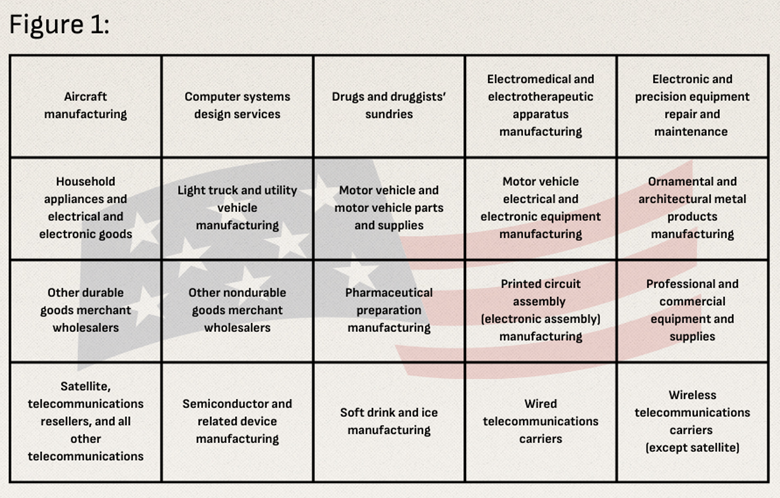
In 2017, downstream industries consumed $69.8 billion worth of semiconductor inputs, with the top 20 consumer industries by value reported in Figure 1 (alphabetical order). The data also shows that the semiconductor industry suffers from a relatively high degree of self-consumption (~7 percent), suggesting there is significant demand for semiconductors within the industry itself. Policy decisions that make semiconductors more expensive would therefore drive up the cost of American businesses manufacturing other semiconductors. That’s counterproductive.
Experiencing rapidly rising demand from AI, data centers, 5G, and consumer electronics, the value of billed shipments of semiconductors in the Americas (a rough but imperfect proxy for consumer demand) increased 120 percent between 2017 and 2024. Scaling the 2017 intermediate input figure by 120 percent suggests downstream industries now consume $153 billion worth of intermediate semiconductor inputs—and the overwhelming majority of those chips are imported from abroad.
Estimates from the Semiconductor Industry Association (SIA) forecast that even after CHIPS Act subsidies—an industrial policy effort to increase domestic chip fabrication and manufacturing—the U.S. share of world chip manufacturing capacity is expected to increase only from 10 percent in 2022 to 14 percent in 2032. The rest of that capacity must be imported—which will make semiconductor tariffs immensely costly.
Even if many semiconductors are exempt from the tariffs, others will not be. Importers directly subject to the tariffs will pay a tax, which will directly raise production costs. Meanwhile, companies not directly subject to the tariffs will be indirectly insulated from competition, giving them margin to raise prices too.
As the Trump administration irons out the details of its semiconductor tariff plan, it must wrestle with the downstream effects on the industries that use semiconductors and the consumers that purchase their products and services. However the order shakes out, the data is clear: semiconductor tariffs are self-defeating. The best way to achieve clarity in this case would be for President Trump to scrap the entire idea before it’s too late.
Logan Kolas is the Director of Technology Policy at the American Consumer Institute, a nonprofit education and research organization. For more information about the Institute, follow us on X @ConsumerPal.